October 2025: US. The State Department designated Nigeria as a “Country of Particular Concern (CPC)” under the International Religious Freedom Act. November 2025: Trump issued a formal warning on social media, using the phrase “guns-a-blazing.” December 2025: The U.S. Congress passed the “Nigeria Religious Freedom Protection and Counter-Terrorism Act of 2025.”
What next? Public narrative of potential military involvement. Exchange of visits at different levels (diplomatic channel). Military plans
Target geographical areas: North Nigeria (East, West, and Central) and surroundings
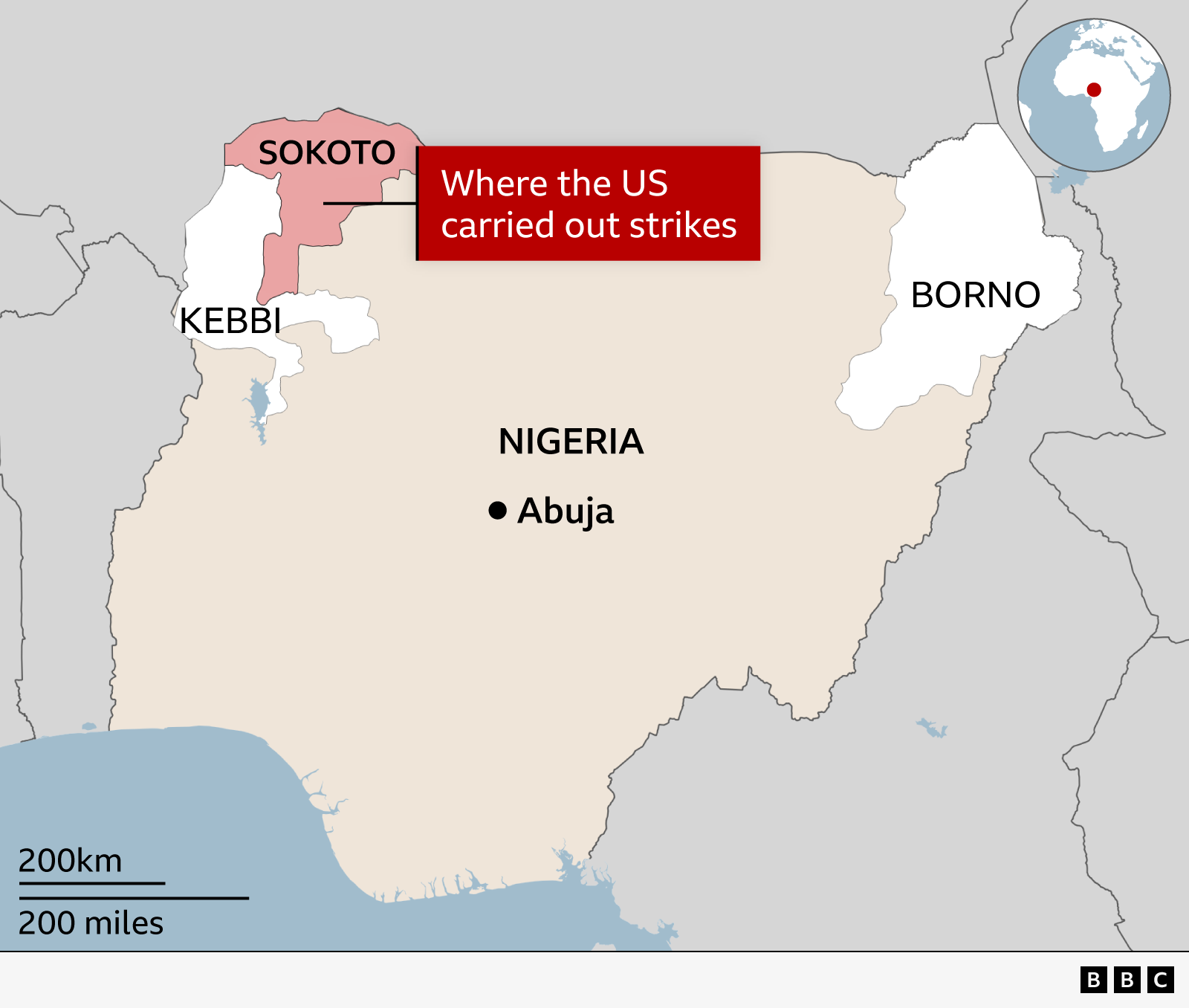
Primary target locations: 1: Banni Forest enclaves, specifically targeted 2 major ISIS enclaves in the Bauni forest axis of the Tangaza LGA. These sites were identified as assembly points used to plan large-scale attacks. 2: Militant Camps in Warriya and Alkassim: Local reports indicated that precision strikes also hit camps in the villages of Warriya and Alkassim, which were known to house terrorists. 3: Border routes: Identified primary routes along the Nigeria-Niger border.
Were missiles and drones launched from the USA? No. They were launched from 1 or more US Navy ships located in the Gulf of Guinea.
Where is the Gulf of Guinea? It is part of the Atlantic Ocean that bordered by numerous West and Central African nations, including Nigeria, Ghana, Cameroon, Angola, Equatorial Guinea, Gabon, Congo (Republic of the), D.R. Congo, Benin, Togo, Côte d’Ivoire, Liberia, Sierra Leone, Guinea, Guinea-Bissau, and the island nation of São Tomé and Príncipe, totaling around 16 coastal countries. So there’s a high probability that the US Navy ship was stationed in Nigeria, Togo, or Ghana shores (Atlantic Ocean), but was stationed at the Gulf of Guinea.
Why was the attack in Offa? There was no targeted attack on Offa; what happened in Offa was the fall of debris from a munition. When missiles are moving, it takes off some shielding in its body; debris from expended munitions fell in Jabo, Sokoto State, and in Offa, Kwara State, near a hotel, but no civilian casualties were reported. The operation happened between 12:12 and 1:30 a.m. local time.
Weapons: Joint Military operation conducted by the USA and Nigeria. The primary US strike involved missiles and drones. Tomahawk Cruise Missiles: Launched from a US Navy warship identified as the Arleigh Burke-class destroyer USS Paul Ignatius, stationed in the Gulf of Guinea. MQ-9 Reaper Drones: These unmanned aerial platforms are used to deploy 16 GPS-guided precision munitions. Launched from the Gulf of Guinea. Precision-Guided Munitions: In addition to the Tomahawks, the operation utilised high-precision bombs to target Islamic State (ISIS) camps and logistics hubs in the Bauni forest of Tangaza. Nigeria Air Force Support: Alpha-Jets, L-39 aircraft, and MI-35 helicopters for reconnaissance and follow-up
Short information about the Weapons: What to know about Tomahawk Land Attack Missile (TLAM): It is a long-range subsonic, all-weather cruise missile. Its primary characteristics include high precision, low-altitude flight to evade radar, and the ability to be retargeted mid-flight. Tomahawk is so unique that after launch to attack its target, if the target changes direction, it can hang, delay, or be redirected.
Core Technical Specification: Range: Depending on the variant, the operational range is 1600km and 2,500km (approx. 1000 to 1550 miles). It can cover twice the size of Nigeria or to Mali if fired from the coast of Lagos. Speed: High subsonic of approximately 880-920km/h. Payload: Typically carries a 450kg high-explosive conventional unitary warhead
The MQ-9 Reaper is a large, unmanned combat aerial vehicle (UCAV) by General Atomics, used by the U.S. Air Force and allies for persistent surveillance (ISR) and strike missions, known for its endurance, powerful sensors, and ability to carry precision weapons like Hellfire missiles, acting as a larger, more capable evolution of the Predator drone with significant intelligence, reconnaissance, and attack capabilities in diverse environments. MQ-9 Reaper drones were used in the U.S. airstrike that killed Iranian Major General Qassem Soleimani near Baghdad Airport in January 2020
Will the US do this for free?
I don’t think so because Trump has been pushing for America First. There might be an agreement between Nigeria and the USA; they can leverage on Nigeria’s foreign reserve, American companies in Nigeria, or any other partnership. All that equipments were not made for free, while the US have highest military budget in the World followed by China and Russia.
Is the US familiar with this terrain, or is it a Global issue? The U.S. military operated in the Republic of Niger, but the troops were withdrawn by August 2024, following a request from Niger’s ruling junta after a 2023 coup, while the Republic of Niger shared a border with Sokoto (a state in Nigeria), where the military action also took place. It was a joint action by the military of Nigeria and the USA, while the Nigerian military understood the terrain
What Next? In a post on social media, Defense Secretary Pete Hegseth said there was “more to come,” without expanding further, and added he was “grateful for Nigerian government support & cooperation.” According to the Nigerian Government, it is ready and willing to work with any country that will help it fight terrorism.
#US_NGRiswapAttackReview. Sources: Channels TV, Wikipedia, BBC, Al Jazeera, CNN
 kayodeteslim